What home insurance usually pays for
The Insurance Bureau of Canada, the national industry association for home and car insurers, says that most personal property policies — homeowner, condominium unit owner and tenant — cover the cost of alternate accommodation and living expenses when an insured loss leaves a home unliveable. In the policy it is usually called Additional Living Expenses, or ALE, and sometimes Coverage D.
Two details in IBC's description matter when you are choosing where to stay. ALE covers costs over and above your normal expenses rather than all of them: it pays for being displaced, not for living. And it typically runs for a reasonable time to repair or rebuild the home, or until the policy limit is reached — so both a dollar limit and a time limit may apply, and they are set by your policy rather than by anything general.
A renovation you chose is a different case. A kitchen you decided to replace is not an insured loss, so the accommodation is your own cost. Everything else in this guide still applies to it, including the tax rule, which is often the biggest single number on a month's bill.
Settle these with your adjuster before booking
IBC's advice is to ask your insurer whether you are eligible for ALE under your policy and for how long. In practice that is four questions worth having answered in writing before you commit to anywhere: the limit, in dollars and in time; whether the insurer pays the accommodation provider directly or reimburses you afterwards; whether a furnished house is acceptable to them in place of a hotel, and up to what nightly figure; and how they want the receipts presented.
Keep every receipt and invoice from the day you leave the house. IBC says so plainly, and it is the part of a displacement that is hardest to reconstruct later. A direct booking here produces a card receipt from Stripe with accommodation, fees and HST shown as separate lines rather than one lump total, which is the form an adjuster usually needs.
IBC also gives an example worth keeping in mind: if your temporary accommodation has no laundry and you have to use a laundromat, that cost may qualify too. The simpler answer is a place with a washer and dryer in it, which removes a weekly claim line altogether.
Why a whole house rather than hotel rooms
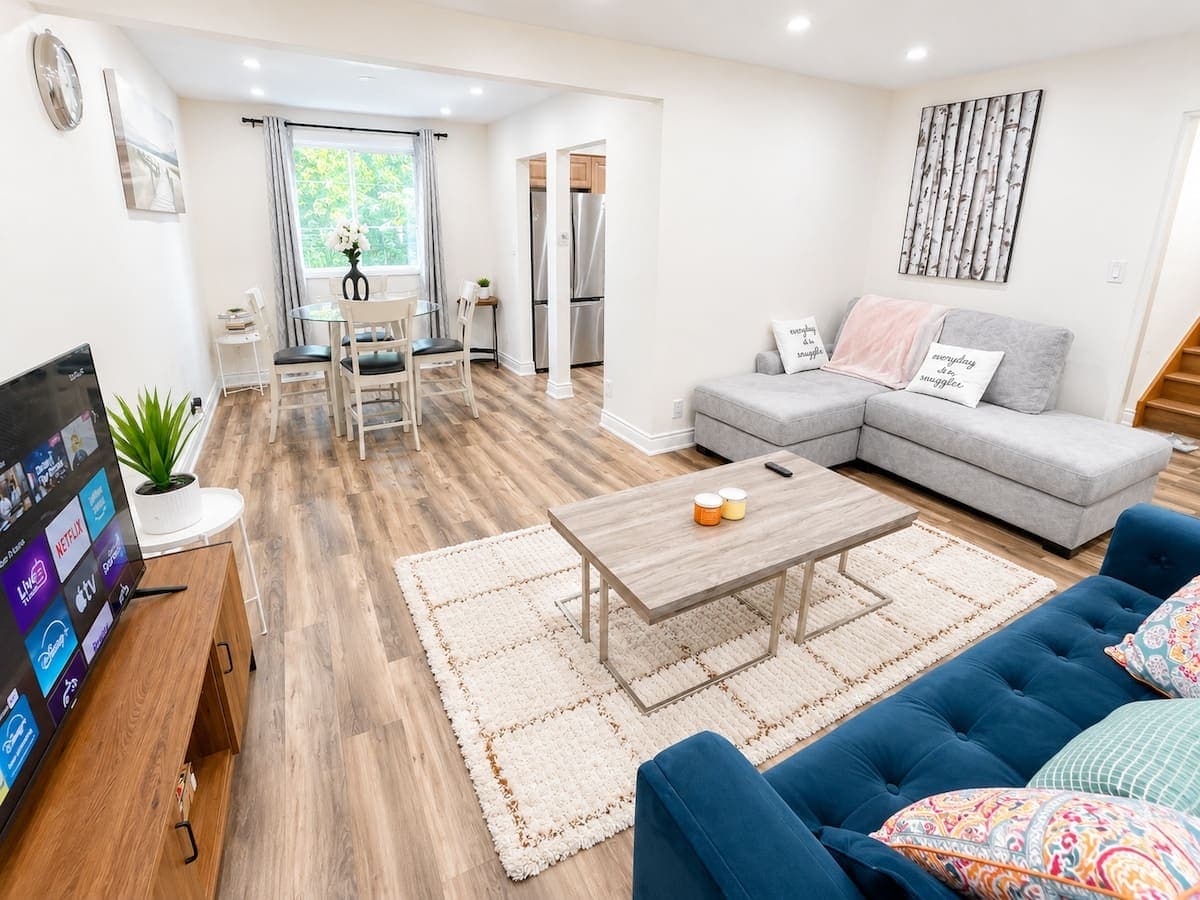
A displaced household is rarely two adults and a suitcase. It is children who still have school in the morning, someone who still has to work, a dog that cannot go into storage, and a routine that a pair of adjoining hotel rooms cannot hold for six weeks. Ebstad Luxe is a detached 3-bedroom house in north Waterloo, rented as an entire place: three bedrooms with a queen bed in each, sleeping up to 6, and two and a half bathrooms.
The kitchen is a working one — fridge and freezer, stove and oven, dishwasher, microwave, kettle, coffee maker and cooking basics — so the family can eat normal dinners instead of claiming restaurant meals. There is a washer and a free dryer in the house, a dedicated workspace with Wi-Fi in a room of its own, free parking on the premises and a private, fully fenced backyard. Heating, air conditioning and Wi-Fi come with the rate; nothing is metered or billed separately.
Pets are welcome at CAD 125 per pet, charged once per stay rather than per night, which matters when the alternative is boarding an animal for the length of a repair.
The rooms, the workspace and the parking are described one by one on the page about the 3-bedroom Waterloo house, and the pet fee is worked through in the guide to staying here with a dog.
What a month costs, and how the bill reads
A 30-night stay, priced against every bookable check-in date in the rate calendar on 11 October 2026, came to between CAD 8,176 and CAD 8,909 in total. That covers accommodation, the CAD 65 cleaning fee and the 6% service fee, with no HST at all, because a continuous stay of 30 nights or more is exempt. Ninety nights, the longest stay bookable online, priced between CAD 24,479 and CAD 26,143. Rates follow a live calendar, so the booking page is the quote for your actual dates.
The breakdown has at most five lines — accommodation, cleaning, a pet fee if one applies, the 6% service fee and HST — and nothing is added afterwards. There is no utility charge, no internet charge, no furniture rental, no key deposit and no administration fee, so the figure you send an adjuster before booking is the figure on the receipt.
If someone other than you is paying, choose “Request to book without paying now” at the last step of the booking page. The dates are confirmed with you and the stay is invoiced directly rather than charged to a card. Whether your insurer will settle an invoice itself or reimburse you is their decision, which is why it is one of the four questions above.
When nobody can tell you the end date
Repairs overrun. A contractor waits for a part, an inspection is rebooked, a drywall crew arrives a week late. Three rules here are worth knowing before you choose a length, because each of them interacts with an uncertain end date.
First, the HST exemption looks at one continuous booking. Thirty nights followed later by a separate five-night booking is thirty exempt nights and five taxed ones, not thirty-five exempt. Second, a stay of 27, 28 or 29 nights costs more in total than the same stay booked at 30, because the exemption removes 13% from the whole bill while one more night adds only about a thirtieth of it. Third, leaving early does not refund the unused nights, and an extension is a new booking subject to availability and the rates current at the time.
So the practical approach is to book the length your adjuster or contractor is reasonably confident of, round anything in the high twenties up to thirty, and raise an extension as early as you know you need one. Cancelling 30 or more days before check-in is a full refund; between 14 and 29 days, half the accommodation total comes back and the cleaning and service fees are returned in full; inside 14 days the accommodation total is not refunded. Stays longer than 90 nights are arranged directly rather than through the online checkout.
The arithmetic behind the 27-to-29-night trap is set out with real figures in the guide to the 30-night HST rule.
What this house cannot do
It is one house, let as a whole, so the dates are either free or they are not. The availability calendar on the booking page is synchronised with the Airbnb, Booking.com and Vrbo listings through the day, and it is the only reliable answer to whether a particular week is open — check it before you promise an adjuster anything.
Six guests means three rooms shared in pairs; a household that needs six separate beds will not fit. There is no front desk: entry is self check-in with a lockbox from 4 PM, and check-out is by 11 AM. The cleaning fee covers the clean at the end of the stay, and housekeeping during a longer stay is available at extra cost rather than included.
Where the house is
389 Dunvegan Drive is a quiet residential street in north Waterloo. The University of Waterloo, Wilfrid Laurier University and Uptown Waterloo are each roughly 10 minutes by car outside rush hour, and Conestoga station, the northern end of the ION light rail, is about 5 minutes' drive. Driving times are approximate and assume no traffic.
For a family whose own house is elsewhere in the region, that usually means the same schools, the same commute and the same contractor visits with a drive in between rather than a move across the city. Parking is free and on the premises, so two cars, or a trip back to the house to meet a trade, need no permit.
If your stay is likely to run a month or more, monthly furnished rentals in Waterloo covers how longer stays are priced and what is included.